
In memory of all the Cheynets whose honor has been harmed for forty years through the falsification and defilement of their surname.
"The Cheynet family is absolutely non-noble." Association d'entraide de la noblesse francaise[1], May 17, 2016.
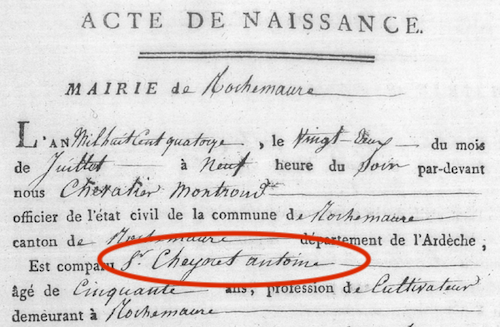
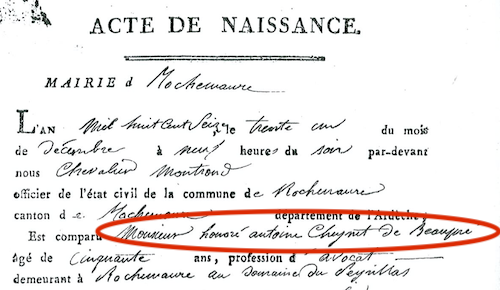
An investigation of national and historical significance, recognized by the courtsIn its judgment of December 3, 2018, the Dijon court recognized that "the investigation was carried out seriously" and that our website should remain online. The court also stressed that "it is undeniable that the falsification of certain civil records has been established. The defendants therefore had the necessary elements to make these allegations." In its interim order of October 15, 2020, the Paris Judicial Court held that the public interest of our website "extends beyond the purely private sphere, in view of the genealogical developments and the historical details" and that it should therefore remain online. In its judgment of June 2, 2021, the Paris Judicial Court recognized that "This change [from the name Cheynet to Cheynet de Beaupre], granted by the public prosecutor on November 5, 1985, was clearly granted with the help of forged civil records [...]." The Cheynet "de Beaupre" affair for newcomersThe earliest traces that can be found of the surname Cheynet de Beaupre date from 1983. But it was probably in the previous years, around 1981 or 1982, that dozens of our Cheynet ancestors' civil records were forged at Rochemaure Town Hall in order to create the appearance of this entirely invented title of nobility. This colossal undertaking, which involved copying records in full, forging others, and cutting, pasting, and sewing civil registers back together, was recorded by a bailiff and is now the subject of a criminal complaint against persons unknown filed by Rochemaure Town Hall. A few years later, in 1985, the particle von Priel was in turn added to the name Pustianaz in order to provide that family with a noble and prestigious ancestry. The aim of whoever was behind this large-scale civil-record forgery was to claim descent from the La Rochefoucauld and Borghese families, no less.
The fact that two related families should discover a supposedly "forgotten" particle at exactly the same time is especially troubling. Statistically, it is about as likely as winning the national lottery jackpot. Every civil record, whether birth, marriage, or death, is always produced in duplicate, with one copy kept at the town hall and the other sent to the departmental archives. In the 1980s, when these forgeries took place, the copy held at the town hall could be consulted freely, whereas the second copy was accessible only to legal professionals such as notaries, lawyers, and judges.
That was when the truth began to emerge clearly: the civil records held at Rochemaure Town Hall bore the name Cheynet de Beaupre, whereas the records kept in the Ardeche archives bore the name Cheynet. Spot the discrepancy. Many other disturbing facts lie behind this process: the desecration of a chapel and graves, the forgery of a plan in the National Archives, and even a fake letter from Pope Pius X. Our website seeks to document these identified acts of damage as exhaustively as possible. The Cheynet de Beaupre affair is a case of destruction of national, regional, and local heritage. Such an imposture must be exposed, made known to all, and condemned. |
||
Site contentsYou will find on this website:
|
The name Cheynet "de Beaupre", a purely modern inventionWe now have proof that the name Cheynet de Beaupre never existed. Indeed, the final piece of alleged evidence advanced for the existence and nobility of a Cheynet de Beaupre family was a document held in the Ain departmental archives under the shelfmark AD 42 B3. This shelfmark was supposedly the "Order of the elected officials of Bresse of July 1768 registering letters patent confirming nobility issued in March 1768." When we consulted the Ain archives in 2018, the archivist in charge told us that the shelfmark in question had nothing whatsoever to do with any lawyer in the Parliament of Dombes. It actually refers to court registers of the Chambre du Tresor de la Dombes dating from 1635 to 1647. Furthermore, research carried out in the Ain archives did not uncover a single document bearing the surname Cheynet, only one Cheynel who has nothing to do with our family. There is therefore absolutely no known authentic archive mentioning the name Cheynet de Beaupre, and we can conclude that this particle-bearing surname is a pure invention. |
|
Notes and References
1. Website of the Association d'Entraide de la Noblesse Francaise (ANF)